
Roots & Wings Complaints
Policy & Procedures
2025-27
Last reviewed: September 2025
Introduction
It is vital for Roots & Wings to have the right attitude towards complaints. The manner in which they are handled is an important element in how our organisation cares for our staff, volunteers and service users and how it presents itself to the world at large. Well-founded complaints should be seen as an opportunity to put things right and to improve the organisation’s way of working.
General Principles
All complaints are to be dealt with as quickly and efficiently as possible. The time taken will vary with the gravity and complexity of the complaint and the urgency with which it needs to be settled. The intention is that all complaints should be settled within a period which is reasonable taking into account all the circumstances. All complaints will be investigated fully, fairly and carefully and complainants will be kept informed of progress at each stage. It is expected that complaints should be made in a respectful manner. Any complaints which are abusive or threatening will not be tolerated and so will not be responded to. Roots & Wings is unable to respond to anonymous complaints.
Expectations
Roots & Wings expects to treat complainants with courtesy and dignity and expects that staff will be treated in the same way by complainants. Abusive language and threatening behaviour will not be tolerated and any conversation or meeting where unacceptable behaviour is displayed will be terminated.
Definitions & Scope
- Definitions
Roots & Wings takes concerns seriously and will make every effort to resolve the matter as quickly as possible. Many issues can be resolved informally, without the need to use the formal stages of the complaint’s procedure. It is in everyone’s interest that concerns and complaints are resolved at the earliest possible stage. It is important to recognise that there may be different levels of concern or complaint to bring to the attention of staff at Roots & Wings so it is helpful to identify the difference between a concern and a complaint
a) A concern may be defined as ‘an expression of worry or doubt over an issue
considered to be important for which reassurances are sought’.
b) A complaint may be defined as ‘an expression of dissatisfaction however made,
about actions taken or a lack of action’.
Initially, it is likely that concerns (as understood in the definition above) will be raised with the appropriate member of staff at Roots & Wings. If the member of staff contacted feels unable to deal with a concern, we will refer you to another staff member. The member of staff may be more senior but does not have to be. The ability to consider the concern objectively and impartially is more important. If after informal contact of this nature, the issue remains unresolved, the next step is to make a formal complaint. We understand, however, that there are occasions when people would like to raise their concerns formally. This may be because the concern has not been resolved at the informal stage or where the concern is complex and merits wider investigation. In these cases, the organisation will attempt to resolve the issue through the stages outlined in this procedure.
2.Scope
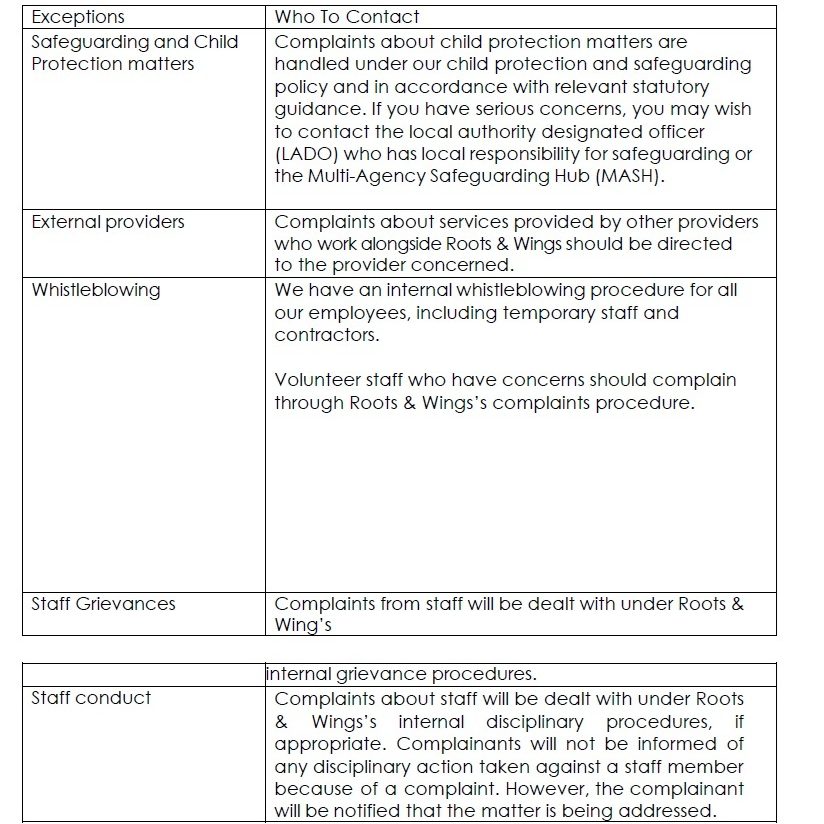
This procedure covers all complaints about any provision of community facilities or services by Roots & Wings other than complaints that are dealt with under other statutory procedures, including those listed below.
How to raise a concern or make a complaint
A concern or complaint can be made in person, by email, in writing or by telephone. It may also be made by a third party acting on behalf of a complainant, if they have appropriate consent to do so. For ease, a template complaint form is included at the end of this procedure. This form should be used if you have been unable to resolve your complaint at Stage 1 of the Complaints Procedure or if the nature of your complaint is complex and wide ranging, meriting an investigation at Stage 2 of the Complaints Procedure. Once completed, it should be returned in person to Roots & Wings or via email to the Director, Rachel Gillett (rachel@gillett-training.com)
If you require help in completing the form, please contact the Roots & Wings office. You can also ask third party organisations such as Citizens Advice to help you. If you prefer not to use the form, please ensure that the relevant details are provided to help us investigate your complaint effectively. In accordance with equality law, we will consider making reasonable adjustments, if required, to enable complainants to access and complete this complaints procedure. For instance, providing information in alternative formats, assisting complainants in raising a formal complaint or holding meetings in accessible locations.
Complaints about Roots & Wings staff
a) Complaints about Roots & Wings staff should be made to the Director
b) Complaints that involve or are about the Director should be addressed to Companies House.
3. Anonymous complaints
We will not normally investigate anonymous complaints. However, the Director, if appropriate, will determine whether the complaint warrants an investigation.
4. Time scales for making a complaint
Complaints must be raised within three months of the incident or, where a series of associated incidents have occurred,
within three months of the last of these incidents. We will consider complaints made outside of this time frame if
exceptional circumstances apply. If other bodies are investigating aspects of the complaint, for example the police, local
authority (LA) safeguarding teams or Tribunals, this may impact on our ability to adhere to the timescales within this
procedure or result in the procedure being suspended until those public bodies have completed their investigations.
If a complainant commences legal action against Roots & Wings in relation to their complaint, we will consider whether to
suspend the complaints procedure in relation to their complaint until those legal proceedings have concluded.
5. Complaints received outside of the working week/Roots & Wings office closure
We will consider complaints made outside of the working week or during our office closure over the Christmas period, to
have been received on the first day after the holiday period. We will consider complaints made on a weekend or
bank Holiday on the first working day following that date.
6. Withdrawal of a Complaint
If a complainant wants to withdraw their complaint, we will ask them to confirm this in writing.
7. Resolving complaints
At each stage in the procedure, Roots & Wings aims to resolve the complaint. We may offer one or more of the
- following:
- an explanation
- an admission that the situation could have been handled differently or better
- an assurance that we will try to ensure the event complained of will not recur
- an explanation of the steps that have been or will be taken to help ensure that it will not happen again and an indication of the timescales within which any changes will be made
- an undertaking to review Roots & Wings policies considering the complaint
- an apology.
In addition, at the formal stages of the procedure, we will acknowledge the outcome of the investigation into your complaint and whether it has been upheld in full or in part.
Section C: Stages of Complaint
1. Stage 1: Informal Complaint or Concern
Stakeholders may wish to ask questions or express an opinion, and the organisation aims to create an environment that supports, welcomes and respects the involvement of others. The organisation will take informal concerns seriously and make every effort to resolve the matter quickly. It may be that the provision or clarification of information will resolve the issue. It is hoped that most concerns can be expressed and resolved on an informal basis, without the need for further procedures. Concerns can be raised in person, in writing (letter or email) or by telephone.
This stage of the procedure will involve a meeting or conversation between the complainant and the relevant member of staff, followed by an investigation into the matters raised. At the conclusion of their investigation, the member of staff investigating the complaint will provide an informal written response via email or letter of the outcome and relevant actions. The response will be provided within 5 working days. If the complaint is not resolved informally following the steps outlined above, the next step is a formal complaint. The procedure for this is outlined below at Stage 2 and this should be followed if the initial attempts to resolve the issue have been unsuccessful and the complainant remains dissatisfied and wishes to take the matter further. If the complainant is unsure about how to direct a concern or query, or if it is about a general organisation issue, they should feel free to raise the issue with the CEO, the Deputy CEO or another member of the organisation’s Leadership Team without this being categorised as a formal complaint. At this point, the concern may be passed on to the most appropriate member of staff for a response.
2. Stage 2: Formal Complaint
Formal complaints should be raised with the Director in writing (preferably on the Complaint Form) via the Roots & Wings office or, if the complaint is about the Director, with Companies House. The Director will record the date the complaint is received and will acknowledge receipt of the complaint and notify the complainant of the name of the allocated Investigating Officer in writing (either by letter or email) within 2 working days. The Investigating Officer is likely to be a member of the organisation’s Leadership Team who will contact the complainant to clarify details about the complaint or to seek further information about what remains unresolved and what outcome the complainant would like to see. The Investigating Officer will conduct a thorough investigation into the complaint. This may include interviewing those involved in the matter and/or those complained about. Any parties interviewed may be accompanied. A written record of any meetings or interviews will be kept as part of the investigation process.
At the end of the investigation, the Investigating Officer will present their findings to the Director who will decide the outcome of the complaint and the actions to be taken. The Director will provide a formal written response within 15 working days from the date of receipt of the complaint.
If the Director is unable to meet this deadline, they will provide the complainant with an update and revised response date. The response will detail any actions taken to investigate the complaint and provide a full explanation of the decision made and the reason(s) for it. Where appropriate, it will include details of actions that the organisation will take to resolve the complaint and any wider lessons learned as a result of hearing the complaint.
In addition, the Director will advise the complainant of how to escalate their complaint should they remain dissatisfied with the outcome of Stage 2. If the complaint is about the Director, a suitably skilled HR professional will be appointed to complete all the actions at Stage 2.
3. Stage 3: Panel Hearing
If the complainant is dissatisfied with the outcome at Stage 2 and wishes to take the matter further, they can escalate the complaint to Stage 3 which is the final stage of the complaints procedure. This stage involves a panel hearing comprising 3 members of an independently convened panel who are not involved in the management and running of the organisation. A request to escalate to Stage 4 must be made to the Director, via the Roots & Wings office, within 10 days of receipt of the Stage 2 response. Requests received outside of this time frame will only be considered if exceptional circumstances apply.
The Director will record the date the complaint is received and acknowledge receipt of the complaint in writing (either by letter or email) within 5 working days.
Requests received outside of this time frame will only be considered if exceptional circumstances apply.
The Director will write to the complainant to inform them of the date of the meeting. They will aim to convene a meeting within 15 working days of receipt of the Stage 3 request. If this is not possible, the Director will provide an anticipated date and keep the complainant informed. If the complainant rejects the offer of three proposed dates, without good reason, the Director will decide when to hold the meeting. It will then proceed in the complainant’s absence on the basis of written submissions from both parties.
The Stage 3 hearing will be heard by a completely independent committee panel
A complainant may bring someone along to the panel meeting to provide support. This can be a relative or friend. Generally, we do not encourage either party to bring legal representatives to the committee meeting. However, there may be occasions when legal representation is appropriate. For instance, if an organisation employee is called as a witness in a complaint meeting, they may wish to be supported by union and/or legal representation.