Roots & Wings Safeguarding Policy
Context
We are an independent training and consultancy company, focusing on high quality work in adoption, fostering and special guardianship. Our training courses cover a wide variety of topics, and we also offer bespoke training.
All our trainers are highly qualified and experienced in their field of work and have many years working with and supporting families of care- experienced children. We are a unique training provider as all our trainers are adoptive parents and have extensive lived experience as well as professional expertise in a variety of fields including education, the charity sector and therapeutic services.
1. Opening Statement
1.1 Every adult, child or young person deserves to be happy and secure in their activities and needs to feel sure that the people in charge of these activities are trustworthy, responsible and will do everything they can to keep every individual safe from harm. Roots & Wings has put in place safeguards to protect the individuals with whom we work, and all staff and volunteers are required to follow this policy and maintain the wellbeing of anyone accessing our services.
2. Our Commitment
2.1 Roots & Wings is committed to safeguarding and promoting the welfare of all individuals with whom our staff and volunteers come into contact. We believe that:
● All individuals have equal right to be protected from harm;
● All individuals have the right to speak freely and voice their values and beliefs;
● All individuals have equal right to be protected from harm;
● All individuals need to be safe and to feel safe;
● All individuals need support which matches their individual needs, including those who may have experienced abuse;
● All individuals must be encouraged to respect each other’s values and support each other;
● All individuals have the right to be supported to meet their emotional, and social needs as well as their educational needs – a happy healthy sociable child/young person will achieve better educationally;
● All staff and volunteers have an important role to play in safeguarding children and protecting them from abuse.
3.1. Safeguarding is defined as:
the act of protecting people, particularly vulnerable groups like children and adults, from harm, abuse, and neglect. It involves preventing harm, protecting health and wellbeing, and responding effectively when issues arise, while also promoting an individual's right to live in safety. Safeguarding is not just about responding to abuse but also about creating environments where people feel respected and valued, and have the ability to report concerns.
This includes, but is not limited to safeguarding individuals in specific circumstances:
- Neglect
- Emotional abuse
- Bullying, including online and
prejudice-based bullying which may include - Physical abuse
- Sexual abuse
- Racist, disability and homophobic or transphobic abuse
- Disinformation, misinformation and conspiracy theories
- Gender based violence / violence against women and girls
- Child Sexual Exploitation and Trafficking
- Teenage relationship abuse Gang / youth violence
- Female Genital Mutilation Fabricated / induced illness Child on child abuse
- Radicalisation and /or extremist behaviour
- The impact of new technologies on sexual behaviour e.g. sexting
- Substance abuse
- Domestic abuse / violence including children witnessing the ill-treatment of others particularly
- when children see, hear or experience domestic abuse and its effects.
- Forced Marriage Poor parenting
- Over- sexualized behaviour patterns
4. Safeguarding aims
4.1 To create an environment which is safe and secure for all individuals.
4.2 To enable individuals to have self-confidence, sense of identity and the vocabulary to resist inappropriate approaches.
4.3 To encourage individuals to establish and sustain satisfying relationships within their families, with peers, and with other adults.
4.4 To encourage individuals to develop a sense of autonomy and independence.
5. Key Principles
5.1 The key principle of safeguarding is that Safeguarding is everybody’s responsibility. This is reinforced within the Statutory Guidance “Keeping Children Safe in Education (2019)”.
5.2 In addition, Roots & Wings has identified the following key safeguarding messages for when working with children and their families:
- Always see the child first and consider what life is like for the child maintaining a culture of vigilance.
- Provide support and intervention at the earliest possible opportunity in the least intrusive way in accordance with local authority frameworks and thresholds (this will vary depending on the home address of the child/family).
- Have conversations, build relationships and maintain professional curiosity.
- Focus on securing improved outcomes for children/families and consider what difference support or interventions have made on an individual’s lived experiences.
- Roots & Wings training sessions and consultancy sessions need to build a culture of openness and transparency where all staff and volunteers demonstrate understanding of their role and responsibility to safeguard and promote the welfare of families and children.
- When issues arise, Roots & Wing’s director should speak out, addressing them internally where possible and engaging in a multi-agency response when required in accordance with interagency procedures.
6. Key Processes
6.1 Key staff should be aware of where to access the guidance issued by Safeguarding Boards in the localities where they deliver services/the families they work with live.
6.2 These documents are integral to safeguarding and will always be used to underpin decision-making.
7. The role of Roots & Wings staff and volunteers
7.1 All Roots & Wings staff and volunteers will:
- Be familiar with this safeguarding policy and implement this consistently in their work with individuals;
- Be subject to Safer Recruitment processes and checks, whether they are new staff, contractors, volunteers, etc.
- Be alert to signs and indicators of possible abuse (see Appendix 1 for current definitions and indicators);
- Record concerns and give the record to the Safeguarding Lead, Rachel Gillett.
- Recognise and respond to concerns about the behaviour of staff, volunteers and individuals which indicates they may pose a risk of harm.
- Deal with a disclosure of abuse from an individual in line with the guidance in Appendix 2.
8. The Role of the Safeguarding Lead
8.1 Our Safeguarding Lead is Rachel Gillett, Director of Roots & Wings, who will provide support to staff members to carry out their safeguarding duties and will liaise closely with other services such as the early help hub, children’s social care, health professionals, police, etc. This person has lead responsibility and management oversight for safeguarding and child protection.
8.2 Where required, the Safeguarding Lead will contribute to any regular case monitoring reviews of vulnerable children/adults. These reviews, together with any actions arising from the review and the rationale for decision-making, will be recorded.
8.3 When Roots & Wings has concerns about a child/adult or family, the Safeguarding Lead will decide what steps should be taken and initiate a response accordingly.
8.4 Safeguarding and child protection information will be dealt with in a confidential manner and in accordance with the Roots & Wings Data Protection Policy. Staff and volunteers will be informed of relevant details only when the Safeguarding Lead feels their having knowledge of a situation will improve their ability to deal with an individual child and / or family.
8.5 It is the responsibility of the Safeguarding Lead to ensure that staff and volunteers are trained correctly.
8.6 The Safeguarding Lead will be responsible for ensuring that filtering and monitoring standards are sufficient to ensure the cyber safety of adults and children. This includes
- Identifying and assigning roles and responsibilities to manage filtering and monitoring systems
- Reviewing filtering and monitoring provision at least annually
- Blocking harmful and/or inappropriate content without unreasonably impacting on the operational needs of the organisation
8.7 Safeguarding and child protection records will be stored securely in a central place.
8.8 If Roots & Wings sends records to a child’s school or Social Services by post, they will be sent by “Special/Recorded Delivery”. Where possible, files will be shared electronically and securely
8.9 When the Safeguarding Lead resigns from Roots & Wings or no longer holds this responsibility, there should be a full face-to-face handover/exchange of information with the new post holder.
8.10 In exceptional circumstances when a face-to-face handover is unfeasible, the member of staff assigned to oversee the charity’s safeguarding will ensure that the new post holder is fully conversant with all procedures and case files.
9. Recruitment
9.1 Our procedure for recruiting staff and volunteers aims to be effective, fair and safe.
9.2 In recruiting a new member of staff or volunteer, we allow sufficient time before appointment to carry out all necessary checks and references. We will not allow any member of staff or volunteer to take up a role without these checks having been completed satisfactorily.
9.3 Applicants for roles within Roots & Wings, whether paid or voluntary, will be clearly informed that the positions are exempt from the Rehabilitation of Offenders Act 1974. Applicants will also be informed of the need to carry out Enhanced DBS checks and take up references before posts can be confirmed. Where applications are rejected because of information that has been disclosed, applicants have the right to know and to challenge incorrect information.
9.4 We abide by the Protection of Children Act requirements in respect of any person who is dismissed from our employment, or who resigns in circumstances that would otherwise have led to dismissal for reasons of a concern about safeguarding.
9.5 At least one member of any recruitment panel will have received appropriate Safer Recruitment training.
10. Line Management
11.1 All staff and volunteers receive regular line management appropriate to their role. As part of line management, line managers ask staff and volunteers if there are any safeguarding concerns they have raised and how they are being dealt with.
11.2 If the line manager believes that safeguarding concerns are not being raised or dealt with correctly by their team of staff or volunteers, they should raise this immediately with the Safeguarding Lead.
11.3 If a member of staff or volunteer consistently fails to follow safeguarding procedures correctly, they will be subject to the Roots & Wings disciplinary procedures.
12. Training
12.1 Safeguarding individuals is a core element of our professional development and training programme for all staff and volunteers.
12.2 All new staff and volunteers complete safeguarding training as part of their induction.
12.3 All staff, volunteers and trustees will receive level one training at least once every three years. Key staff with designated responsibility for safeguarding will undertake higher- level training and will utilise the training opportunities available from appropriate organisations.
13. As part of our induction process, the Safeguarding Lead ensures all staff and volunteers are aware of Roots & Wings’s Safeguarding Policy, and how to report and record any safeguarding concerns.
13.1 We seek to create within Roots & Wings a culture of value and respect for the individual. This is particularly important as many of our projects seek to work directly with children and families who experience a myriad of family challenges, something that, if not dealt with sensitively, could cause stigma or damage an individua’s sense of dignity.
13.2 Therefore, when planning a project, utmost care is given to ensure it is accessible and open to any individual in need.
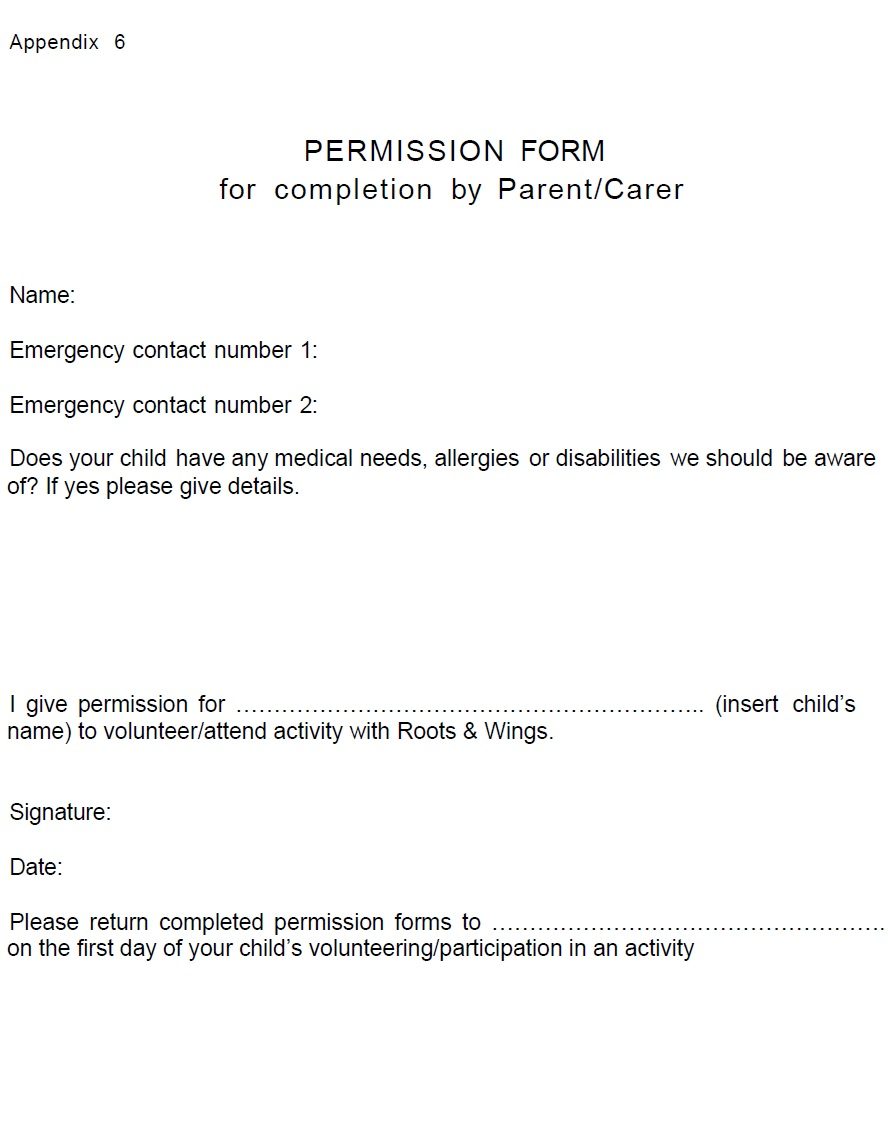
13.3 Any child or young person attending our organised projects must complete a permission form signed by a parent or guardian (see Appendix 6).
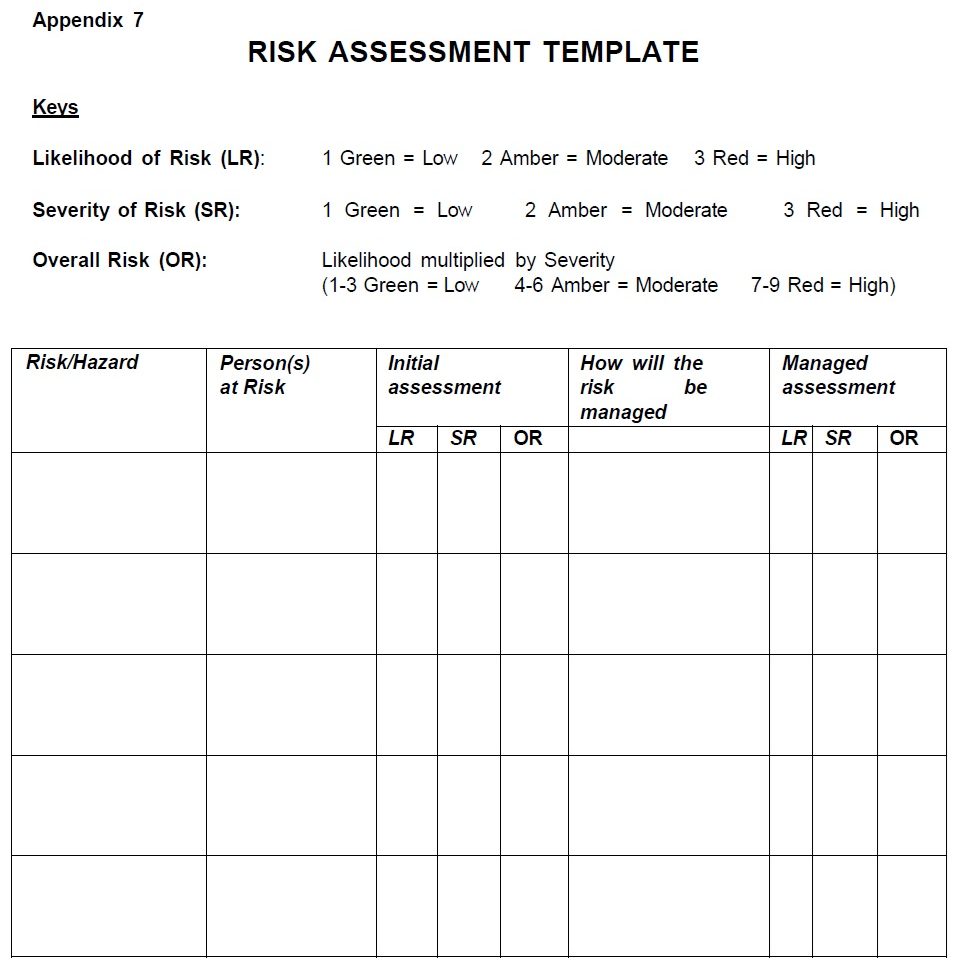
13.4 As part of our project planning, a detailed risk assessment is completed (see Appendix 7). This gives us the specific procedures needed to be followed in each project to ensure the safety of individuals. All staff and volunteers are briefed on the risk assessments for the projects they are involved in. It is the responsibility of the specific project leader to complete this risk assessment. All risk assessments should be checked by the Health and Safety Officer and Safeguarding Lead.
13.5 We ensure that our projects are carried out in a way that is appropriate for the ages, developmental stages and learning and behavioural needs of the individuals attending.
13.6 Where appropriate, we will make individuals aware at the start of a project or activities of Roots & Wings’s safeguarding responsibilities so that individuals can develop an understanding of why and how to keep safe.
13.7 We display a safeguarding statement online which explains what a child, young person or parent can do if they are worried about their safety or the safety of someone they know.
14. Safeguarding Children who are vulnerable to extremism, exploitation, forced marriage, female genital mutilation or trafficking
14.1 Since 2010, when the Government published the Prevent Strategy, there has been an awareness of the specific need to safeguard children, young people and families from violent extremism. There have been several occasions both locally and nationally in which extremist groups have attempted to radicalise vulnerable individuals to hold extreme views including views justifying political, religious, sexist or racist violence, or to steer them into a rigid and narrow ideology that is intolerant of diversity and leaves them vulnerable to future radicalisation.
14.2 Roots & Wings recognises our responsibility to be aware of the pressures that individuals can face from violent extremism, forced marriage, female genital mutilation or trafficking and the importance of spotting the signs of when a child is under pressure and referring this information on.
14.3 When any member of staff has concerns that a child may be at risk, they should speak to the Safeguarding Lead. If a child or young person is thought to be at risk of radicalisation, a referral to the Early Help Assessment team will be made.
14.4 Roots & Wings keeps up to date on the latest advice and guidance provided to assist in addressing specific vulnerabilities and forms of exploitation.
15. Suspected abuse
15.1 When individuals are suffering from abuse, this may be demonstrated through changes in their behaviour and appearance or through abnormal behaviour for their age. Where such changes in behaviour occur, or where there is cause for concern, we will investigate. The signs and symptoms of abuse will vary from person to person. For a detailed overview of signs and symptoms of abuse please visit https://www.nspcc.org.uk/preventing-abuse/signs-symptoms-effects/.
15.2 We recognise the importance that investigations are carried out with sensitivity. Staff and volunteers take care not to influence the outcome, either through the way they speak to or ask questions of the individual.
15.3 It is acknowledged that asking reasonable questions to find out more about a individual’s situation is crucial in ascertaining the individual’s need.
15.4 Where a child or young person shows signs and symptoms of ‘failure to thrive’ or neglect, the appropriate referrals will be made. Parental/Carer permission will be sought before making a referral, unless by seeking this permission would put a child at risk.
15.5 Roots & Wings will work cooperatively with the parent or carer unless this is inconsistent with the need to ensure the child’s safety.
15.6 We recognise that it can be difficult for a parent to be told we are concerned about a child in their care’s safety. We will always make it clear that the reason for raising the concern is for the best interests of helping the child or young person and for making things better for the child.
16. What we do when we are concerned
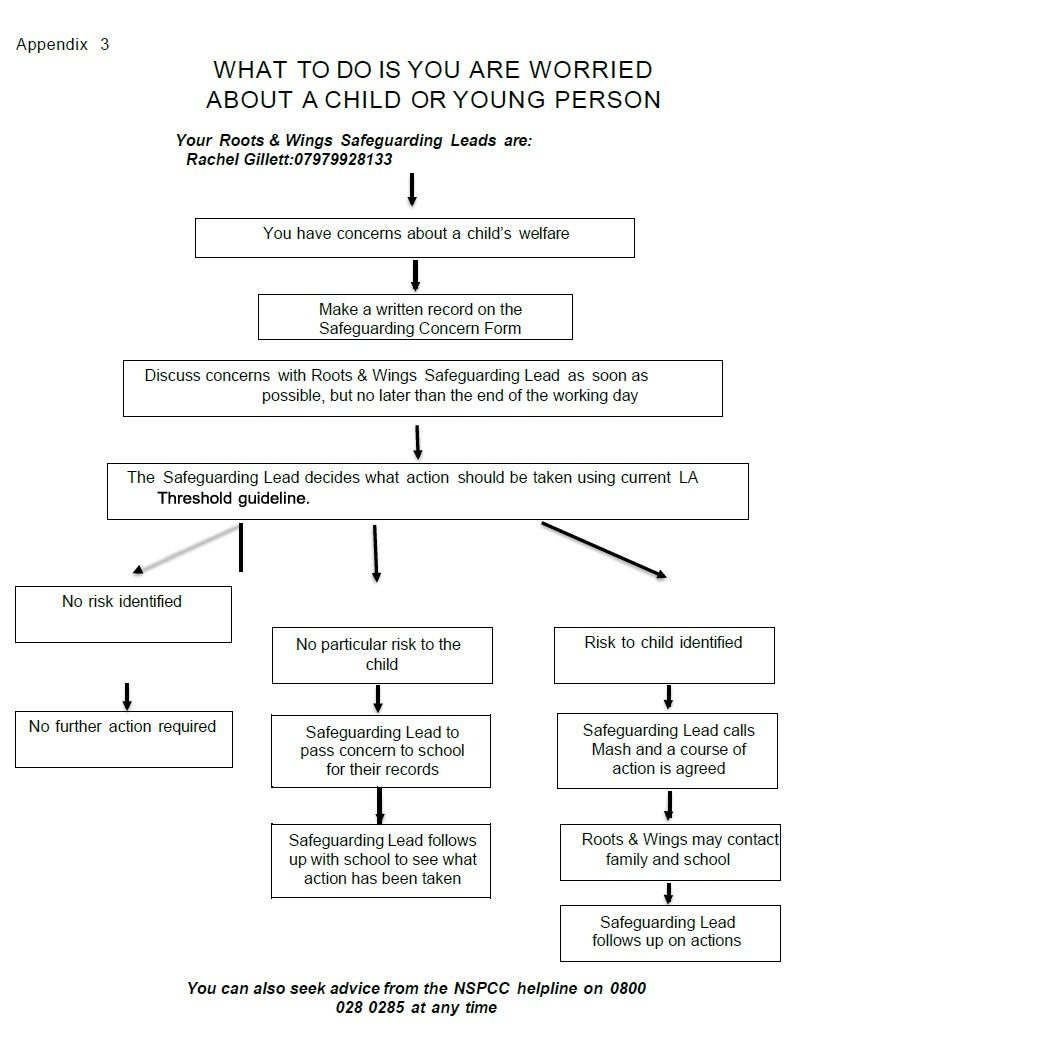
16.1 Staff and volunteers who have a concern must record the concern or disclosure using the appropriate incident report form.
16.2 These records are reviewed by the DSL who will assign appropriate actions.
16.3 If appropriate, the member of staff or volunteer will discuss the incident with the Safeguarding Lead immediately. If the Safeguarding Lead is unavailable, they will refer it to the most senior trainer with Level 3 Safeguarding Training available.
16.4 The Safeguarding Lead will view the concern alongside the relevant Threshold Framework in order to ensure the appropriate support or intervention is provided at the earliest opportunity in the least intrusive way.
16.5 Where risk factors are present but there is no evidence of a particular risk, then the Safeguarding Lead will work with the family and our partners to engage the child and/or family in other activities and services that may be of help so that we can together reduce the risk. The concern will, in most circumstances, be shared with the child’s school as they are often best placed to take a lead on safeguarding concerns. It is the welfare of the individual which is paramount, and this is at the forefront of all our actions.
16.6 If it is deemed that there is a particular risk to the child, then the Early Help Assessment
team should be contacted for advice.
16.7 If it is deemed that the child or young person is at risk of or suffering significant harm a referral will be made to the appropriate MASH. The parent will be informed of the referral unless informing the parent/carer may place the individual at increased risk of harm.
16.8 We are aware that many individuals have suffered because of lack of communication between agencies, and that government guidance now encourages the full sharing of information. We shall therefore use our professional judgement in sharing information with the agencies that ‘need to know’, being open and honest with parents as to why we feel we need to share the information.
16.9 Full records of conversations will be maintained within our central safeguarding records when any referrals or discussions are held with any other agencies or with parents prior to a referral. These records will include dates and times of the conversation, who we speak to, and the advice we were given.
17. Our role in supporting children
17.1 When working with a child or young person who is affected by abuse, neglect or exploitation, we will always do all we can to work sensitively and provide as much support as we can.
17.2 As a small organisation, we recognise the limitations of what we can offer and so will do all we can to refer individuals to other organisations who have the expertise to offer the support that is most appropriate to them.
18. Involving parents and carers
18.1 In general, we will discuss any safeguarding and child protection concerns with parents
/carers before approaching other agencies and will seek their consent before making a referral to another agency. However, there may be occasions when we will contact another agency before informing parents / carers because we consider that contacting them may increase the risk of significant harm to the child.
18.2 Parents / carers will be informed about our safeguarding policy through our website and on request.
19. Multi agency working
19.1 We work in partnership with other agencies in the best interests of all individuals.
19.2 We will co-operate with any child protection enquiries conducted by children’s social care20. Responding to an allegation or concern about a member of staff, volunteer or trustee
20.1 This procedure should be used in any case in which it is alleged that a member of staff or volunteer has:
- Behaved in a way that has harmed a vulnerable adult or may have harmed a child;
- Possibly committed a criminal offence against or related to a child/adult; or
- Behaved in a way that indicates s/he may pose a risk of harm to children/families.
20.2 All staff and volunteers must report any potential safeguarding concerns about an individual’s behaviour immediately. Allegations or concerns about colleagues must be reported directly to the Roots & Wings Director, Rachel Gillett (your email address needs to go in here).
20.3 To report a safeguarding concern about a company director, you must direct your report to the appropriate body based on the nature of the concern and the individuals at risk.
20.4 If the Director is not available, the member of staff should report their concerns to the most senior member of staff available.
20.5 The Director will inform the appropriate organization that a complaint has been raised and will work in partnership with them and other appropriate parties including the police and health to investigate the complaint.
20.6 Whilst a complaint of this nature is being investigated, Roots & Wings may decide it is appropriate for the staff member or volunteer to be suspended from their duties with Roots & Wings. However, all reasonable alternatives to manage the risk will be considered.
20.7 Should Roots & Wings dismiss a member of staff or volunteer as a result of a substantiated allegation, or should a member of staff, volunteer or trustee resign before an investigation has been completed, in accordance with Statutory Duty a referral to the Disclosure and Barring Service will be made.
21. Children with additional needs
21.1 Roots & Wings recognises that while all children have a right to be safe, some children may be more vulnerable to abuse, neglect or exploitation. For example, those with a disability or special educational need, those living with domestic violence or drug / alcohol abusing parents, etc.
22. Children in specific circumstances
22.1 Guidance on children in specific circumstances is listed below:
- Abuse Linked to Spiritual Belief
- Child Sexual Exploitation
- Safeguarding Children vulnerable to Gang Activity
- Supporting individuals vulnerable to violent extremism
- Private Fostering
- Children missing from home or care
- Children missing education
- Children of Parents who Misuse Substances
- Children of Parents with Learning Difficulties
- Working with parents/carers with mental health problems
- Working with parents/carers with disabilities
- Disabled Children
- Protocol for dealing with domestic violence when children are involved
- E-Safety – Children Exposed to Abuse or Exploitation through the Digital Media
- Fabricated or Induced Illness
- Female Genital Mutilation
- Forced Marriage / Honour Based Violence
- Practice Guidance & Procedures to distinguish between healthy and abusive sexual behaviours in individuals
- Safeguarding children who may have been trafficked
- Protocol & Guidance; Working with Sexually Active Young People
- Working with hostile, non-compliant clients and those who use disguised compliance
Appendices
Appendix 1 Definitions and Indicators of Abuse
Page
12
Appendix 2
Dealing with a Disclosure of Abuse
16
Appendix 3
What to do if you are worried about a child or young person
17
Appendix 4
Allegation about a member of staff, trustee or Volunteer
18
Appendix 5
Indicators of vulnerability to radicalization
19
Appendix 6
Parent/Carer Permission Form
21
Appendix 7
Risk Assessment Template
22
Appendix 1
DEFINITIONS AND INDICATORS OF ABUSE
1. Neglect
Neglect is the persistent failure to meet a child's basic physical and/or psychological needs, likely to result in the serious impairment of the child's health or development. Neglect may occur during pregnancy as a result of maternal substance abuse. Once a child is born, neglect may involve a parent or carer failing to:
- Provide adequate food, clothing and shelter (including exclusion from home or abandonment);
- Protect a child from physical and emotional harm or danger;
- Ensure adequate supervision (including the use of inadequate care-givers); or Ensure access to appropriate medical care or treatment.
- It may also include neglect of, or unresponsiveness to, a child's basic emotional needs. The following may be indicators of neglect (this is not designed to be used as a checklist):
- Constant hunger;
- Stealing, scavenging and/or hoarding food;
- Frequent tiredness or listlessness;
- Frequently dirty or unkempt;
- Often poorly or inappropriately clad for the weather;
- Poor school attendance or often late for school;
- Poor concentration;
- Affection or attention seeking behaviour;
- Illnesses or injuries that are left untreated;
- Failure to achieve developmental milestones, for example: growth, weight;
- Failure to develop intellectually or socially;
- Responsibility for activity that is not age appropriate such as cooking, ironing, caring for siblings;
- The child is regularly not collected or received from school; or The child is left at home alone or with inappropriate carers.
2. Physical Abuse
Physical abuse may involve hitting, shaking, throwing, poisoning, burning or scalding, drowning, suffocating or otherwise causing physical harm to a child. Physical harm may also be caused when a parent or carer fabricates the symptoms of, or deliberately induces, illness in a child.
- The following may be indicators of physical abuse (this is not designed to be used as a checklist):
- Multiple bruises in clusters, or of uniform shape;
- Bruises that carry an imprint, such as a hand or a belt;
- Bite marks;
- Round burn marks;
- Multiple burn marks and burns on unusual areas of the body such as the back, shoulders or buttocks;
- An injury that is not consistent with the account given;
- Changing or different accounts of how an injury occurred;
- Bald patches;
- Symptoms of drug or alcohol intoxication or poisoning;
- Unaccountable covering of limbs, even in hot weather;
- Fear of going home or parents being contacted;
- Fear of medical help;
- Fear of changing for PE;
- Inexplicable fear of adults or over-compliance;
- Violence or aggression towards others including bullying; or
- Isolation from peers.
3. Sexual Abuse
Sexual abuse involves forcing or enticing a child or young person to take part in sexual activities, not necessarily involving a high level of violence, whether or not the child is aware of what is happening. The activities may involve physical contact, including assault by penetration (for example, rape or oral sex) or non-penetrative acts such as masturbation, kissing, rubbing and touching outside of clothing. They may also include non-contact activities, such as involving children in looking at, or in the production of, sexual images, watching sexual activities, encouraging children to behave in sexually inappropriate ways, or grooming a child in preparation for abuse (including via the internet). Sexual abuse is not solely perpetrated by adult males. Women can also commit acts of sexual abuse, as can other children. Upskirting (which involves taking a picture under a person’s clothing without their knowledge) is also now a criminal offence.
The following may be indicators of sexual abuse (this is not designed to be used as a checklist):
- Sexually explicit play or behaviour or age-inappropriate knowledge;
- Anal or vaginal discharge, soreness or scratching;
- Reluctance to go home;
- Inability to concentrate, tiredness;
- Refusal to communicate;
- Thrush, persistent complaints of stomach disorders or pains;
- Eating disorders, for example anorexia nervosa and bulimia;
- Attention seeking behaviour, self-mutilation, substance abuse;
- Aggressive behaviour including sexual harassment or molestation;
- Unusual compliance;
- Regressive behaviour, enuresis, soiling;
- Frequent or open masturbation, touching others inappropriately;
- Depression, withdrawal, isolation from peer group;
- Reluctance to undress for PE or swimming; or
Bruises or scratches in the genital area.
4. Sexual Exploitation
Child sexual exploitation (CSE) occurs when a child or young person, or another person, receives “something” (for example food, accommodation, drugs, alcohol, cigarettes, affection, gifts, money) as a result of the child/young person performing
sexual activities, or another person performing sexual activities on the child/young person.
The presence of any significant indicator for sexual exploitation should trigger a referral to children’s social care. The significant indicators are:
- Having a relationship of concern with a controlling adult or young person (this may involve physical and/or emotional abuse and/or gang activity);
- Entering and/or leaving vehicles driven by unknown adults;
- Possessing unexplained amounts of money, expensive clothes or other items;
- Frequenting areas known for risky activities;
- Being groomed or abused via the Internet and mobile technology; and
- Having unexplained contact with hotels, taxi companies or fast food outlets.
The intelligence reporting form on the LSCB website will be used to share information with Police and children’s social care that raises a concern around CSE.
In addition to making referrals to children’s social care, referrals of children thought to be at risk of, or experiencing CSE will be referred to the Child Sexual Exploitation panel.
5. Emotional Abuse
Emotional abuse is the persistent emotional maltreatment of a child such as to cause severe and persistent adverse effects on the child's emotional development. It may involve conveying to children that they are worthless or unloved, inadequate, or valued only in so far as they meet the needs of another person. It may include not giving the child opportunities to express their views, deliberately silencing them or 'making fun' of what they say or how they communicate. It may feature age or developmentally inappropriate expectations being imposed on children. These may include interactions that are beyond the child's developmental capability, as well as overprotection and limitation of exploration and learning, or preventing the child participating in normal social interaction. It may also involve seeing or hearing the ill-treatment of another person. It may involve serious bullying (including cyber bullying), causing children frequently to feel frightened or in danger, or the exploitation or corruption of children. Some level of emotional abuse is involved in all types of maltreatment.
The following may be indicators of emotional abuse (this is not designed to be used as a checklist):
- The child consistently describes him/herself in very negative ways – as stupid, naughty, hopeless, ugly;
- Over-reaction to mistakes;
- Delayed physical, mental or emotional development;
- Sudden speech or sensory disorders;
- Inappropriate emotional responses, fantasies;
- Behaviours such as rocking, banging head, regression, tics and twitches;
- Self harming, drug or solvent abuse;
- Fear of parents being contacted;
- Running away;
- Compulsive stealing;
- Appetite disorders - anorexia nervosa, bulimia; or Soiling, smearing faeces, enuresis.
N.B. Some situations where children stop communication suddenly (known as “traumatic mutism”) can indicate maltreatment.
6. Responses from Parents
Research and experience indicates that the following responses from parents may suggest a cause for concern across all four categories:
- Delay in seeking treatment that is obviously needed;
- Unawareness or denial of any injury, pain or loss of function (for example, a fractured limb);
- Incompatible explanations offered, several different explanations or the child is said to have acted in a way that is inappropriate to her/his age and development;
- Reluctance to give information or failure to mention other known relevant injuries;
- Frequent presentation of minor injuries;
- A persistently negative attitude towards the child;
- Unrealistic expectations or constant complaints about the child;
- Alcohol misuse or other drug/substance misuse;
- Parents request removal of the child from home; or
- Violence between adults in the household.
7. Disabled Children
When working with children with disabilities, practitioners need to be aware that additional possible indicators of abuse, neglect and/or exploitation may also include:
- A bruise in a site that might not be of concern on an ambulant child such as the shin;
- Not getting enough help with feeding leading to malnourishment;
- Poor toileting arrangements;
- Lack of stimulation;
- Unjustified and/or excessive use of restraint;
- Rough handling, extreme behaviour modification such as deprivation of medication, food or clothing, disabling
- wheelchair batteries;
- Unwillingness to try to learn a child’s means of communication;
- Ill-fitting equipment, for example callipers, sleep boards, inappropriate splinting;
- Misappropriation of a child’s finances; or
- Inappropriate invasive procedures.
Appendix 2
DEALING WITH A DISCLOSURE OF ABUSE
When a child tells me about abuse s/he has suffered, what must I remember?
- Stay calm.
- Do not communicate shock, anger or embarrassment.
- Reassure the child. Tell her/him you are pleased that s/he is speaking to you.
- Never enter into a pact of secrecy with the child. Assure her/him that you will try to help but let the child know that you will have to tell other people in order to do this. State who this will be and why.
- Tell her/him that you believe them. Children very rarely lie about abuse; but s/he may have tried to tell others and not been heard or believed.
- Tell the child that it is not her/his fault.
- Encourage the child to talk but do not ask "leading questions" or press for information.
- Listen and remember.
- Check that you have understood correctly what the child is trying to tell you.
- Praise the child for telling you. Communicate that s/he has a right to be safe and protected.
- Do not tell the child that what s/he experienced is dirty, naughty or bad.
- It is inappropriate to make any comments about the alleged offender.
- Be aware that the child may retract what s/he has told you. It is essential to record all you have heard.
- At the end of the conversation, tell the child again who you are going to tell and why that person or those people need to know.
- As soon as you can afterwards, make a detailed record of the conversation using the child’s own language. Include any questions you may have asked on the Safeguarding Concern Form.
You must not deal with this yourself. Clear indications or disclosure of abuse must be reported to the Safeguarding Lead immediately.
Children making a disclosure may do so with difficulty, having chosen carefully to whom they will speak. Listening to and supporting a child/young person who has been abused can be traumatic for the adults involved. Please seek support from the DSL/Director should you require it.
Appendix 4
ALLEGATIONS ABOUT A MEMBER OF STAFF, TRUSTEE OR VOLUNTEER
1. Inappropriate behaviour by staff or volunteers could take the following forms:
- Physical: e.g. the intentional use of force as a punishment, slapping, hitting with an object, throwing objects or inappropriate physical handling.
- Emotional: e.g. intimidation, belittling, scapegoating, sarcasm, lack of respect for children’s rights, and attitudes that discriminate on the grounds of race, gender, disability or sexuality. Excessive or aggressive shouting.
- Sexual: e.g. sexualised behaviour towards peers, sexual harassment, sexual communication including via social networking, email, text, grooming behaviour, sexual assault and rape.
- Neglect: e.g. failing to act to protect a child or children, failing to seek medical attention or failure to meet a child’s basic needs
2. If a child makes an allegation or raises a concern about a member of staff or volunteer, the Director should be informed immediately. If the allegation or concern may fall within the following criteria the Local Authority Designated Officer (LADO) will be contacted at the earliest possibly opportunity and within 1 working day.
- Behaved in a way that has harmed a child or may have harmed a child;
- Possibly committed a criminal offence against or related to a child; or
- Behaved in a way that indicates s/he may pose a risk of harm to children
The Director will not carry out the investigation him/herself or interview individuals.
3.
If a child makes an allegation of physical abuse against an adult that works with children and there are visible bruises, marks or injuries, or if a child makes an allegation of sexual abuse against an adult that works with children, Child Protection procedures will be followed and a referral made to the Rapid Interventions and Assessment Team. The LADO will also be informed.
3.
The Director must exercise, and be accountable for, their professional judgement on the action to be taken, as follows –
- If the actions of the member of staff are felt likely to fall within the scope of the interagency allegation management procedures as stated in point 2, the Director will notify the LADO within the appropriate local authority. The LADO will liaise with the Director and advise about action to be taken which will be in accordance with the interagency procedures for managing allegations.
- If the Director is uncertain whether the concern or allegation falls within the scope of the allegation management procedures, a consultation with the LADO will take place and the advice provided will be acted upon. This consultation and the advice offered will be recorded and held on file.
4. Where an allegation has been made against the Director, then the designated deputy takes on the role of liaising with the LADO team in determining the appropriate way forward.
Appendix 5
INDICATORS OF VULNERABILITY TO RADICALISATION
1. Radicalisation refers to the process by which a person comes to support terrorism and forms of extremism leading to terrorism.
2. Extremism is defined by the Government in the Prevent Strategy as:
“Vocal or active opposition to fundamental British values, including democracy, the rule of law, individual liberty and mutual respect and tolerance of different faiths and beliefs. We also include in our definition of extremism calls for the death of members of our armed forces, whether in this country or overseas.”
3. Extremism is defined by the Crown Prosecution Service as:
“The demonstration of unacceptable behaviour by using any means or medium to express views which:
- Encourage, justify or glorify terrorist violence in furtherance of particular beliefs;
- Seek to provoke others to terrorist acts;
- Encourage other serious criminal activity or seek to provoke others to serious criminal acts; or
- Foster hatred which might lead to inter-community violence in the UK.”
4. There is no such thing as a “typical extremist”: those who become involved in extremist actions come from a range of backgrounds and experiences, and most individuals, even those who hold radical views, do not become involved in violent extremist activity.
5. Children may become susceptible to radicalisation through a range of social, personal and environmental factors - it is known that violent extremists exploit vulnerabilities in individuals to drive a wedge between them and their families and communities. It is vital that staff are able to recognise those vulnerabilities.
6. Indicators of vulnerability include:
- Identity Crisis – the child is distanced from their cultural / religious heritage and experiences discomfort about their place in society;
- Personal Crisis – the child may be experiencing family tensions; a sense of isolation; and low self-esteem; they may have dissociated from their existing friendship group and become involved with a new and different group of friends; they may be searching for answers to questions about identity, faith and belonging;
- Personal Circumstances – migration; local community tensions; events affecting the child’s country or region of origin may contribute to a sense of grievance that is triggered by personal experience of racism or discrimination or aspects of Government policy;
- Unmet Aspirations – the child may have perceptions of injustice; a feeling of failure; rejection of civic life;
- Experiences of Criminality – which may include involvement with criminal groups, imprisonment, and poor resettlement / reintegration;
- Special Educational Need – children may experience difficulties with social interaction, empathy with others, understanding the consequences of their actions and awareness of the motivations of others.
However, this list is not exhaustive, nor does it mean that all young people experiencing the above are at risk of radicalisation for the purposes of violent extremism.
7. More critical risk factors could include:
- Being in contact with extremist recruiters;
- Accessing violent extremist websites, especially those with a social networking element;
- Possessing or accessing violent extremist literature;
- Using extremist narratives and a global ideology to explain personal disadvantage;
- Justifying the use of violence to solve societal issues;
- Joining or seeking to join extremist organisations;
- Significant changes to appearance and / or behaviour;
- Experiencing a high level of social isolation resulting in issues of identity crisis and / or personal crisis.
,
Key Contacts
Rachel Gillett (Designated Safeguarding Lead) – 07979928133
Roots & Wings Office - 07979928133
NSPCC helpline – 0800 028 0285